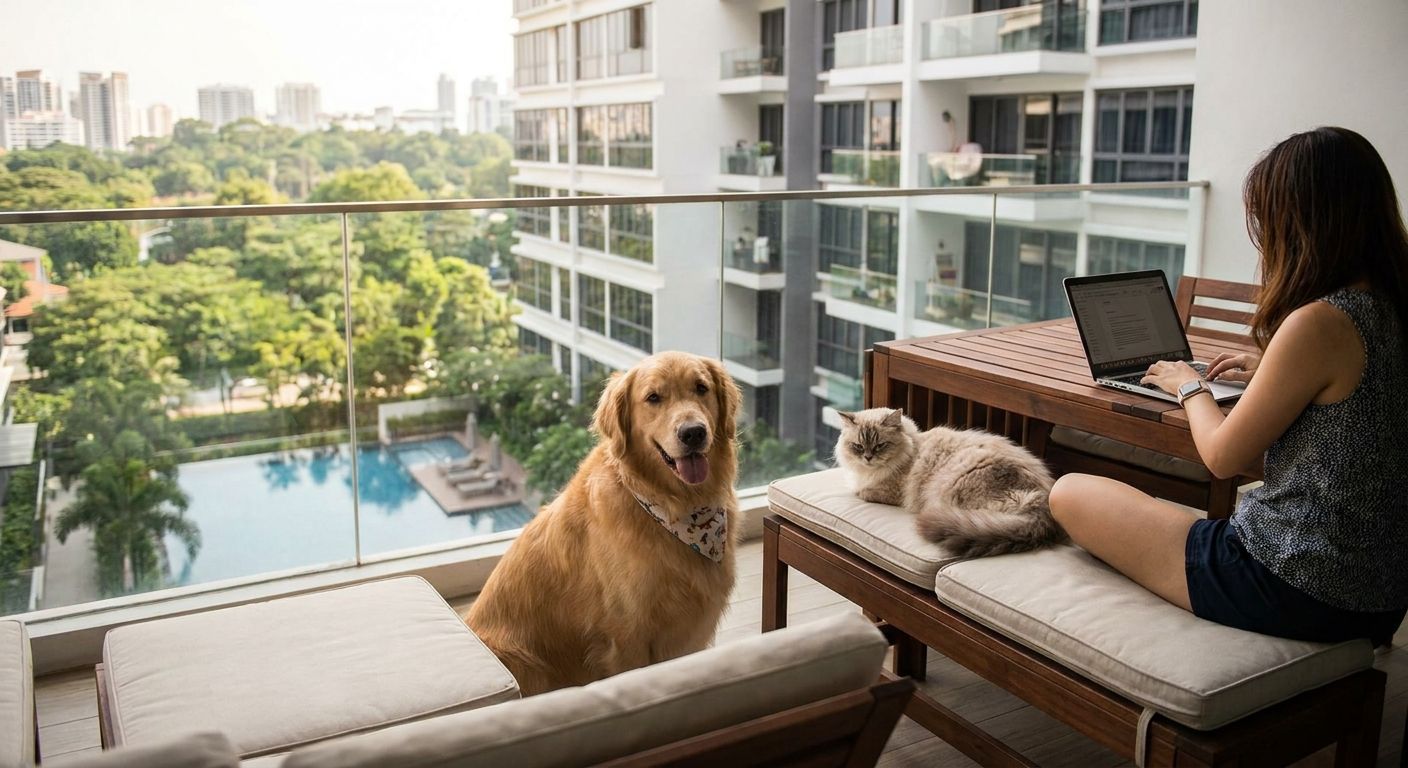
If you've got a dog or a cat and you're hunting for a rental in Singapore, you've probably already discovered the truth: pet policy isn't a government rule, it's a building-by-building, sometimes unit-by-unit decision, and getting it wrong wastes weeks of your search.
- Landed homes remain the safest bet for pet owners renting in Singapore in 2026 - no MCST house rules to fight.
- Low-rise walk-up condos (4-5 storeys, often pre-2000 builds) approve pets far more often than new high-rise towers.
- HDB flats cap pet owners to one dog from NParks' approved breed list - a real constraint for larger dogs.
- Newer condos increasingly write pet clauses into house rules, but always in writing before you sign.
Why this matters
Most tenant complaints I hear in 2026 aren't about rent - they're about a landlord who verbally said "pets are fine" and then the MCST (Management Corporation Strata Title) house rules said otherwise three months in. A pet owner rental search needs to start with the building's actual by-laws, not the listing photo.
Singapore has no single national policy on pets in private condos. HDB flats follow strict NParks rules - one dog per flat, and only from the approved breed list. Private condos set their own pet clauses through their MCST, and those clauses vary wildly between a 1985 walk-up and a 2023 integrated development. That gap is exactly why "best pet-friendly condos for rent in Singapore" isn't a fixed list of addresses - it's a set of building types you should be filtering for.
How I ranked these
I'm not naming specific condo projects here, and there's a reason: pet clauses inside condo house rules get amended by the MCST at annual general meetings, and a building that allowed dogs in 2023 can tighten its rules by 2026 without notice to prospective tenants. Ranking by named development would go stale within a lease cycle.
Instead, this ranks the structural categories of Singapore rental housing by how consistently they accommodate pets, based on how MCST governance, building age, and unit layout interact with pet ownership. Landed housing sits at the top because there's no shared strata council to override the landlord. HDB sits near the bottom for larger dogs because the breed restriction is a hard national rule, not a house preference. Everything in between is ranked on how often I see pet clauses hold up in practice.
The ranked list
1. Landed homes and terraces - the safest bet
No MCST, no shared corridors, no building manager fielding noise complaints about a barking dog. The landlord is the sole decision-maker on pets, which means a straightforward conversation before signing settles the matter entirely.
What it does: gives you full control of a garden or yard space, which matters if you've got a dog over 20kg that a condo's house rules would flag immediately. The trade-off is price and location - landed stock concentrates in districts like 10, 11, and 21, further from the CBD than most condo clusters.
Why now: with more expat families requesting pet-friendly housing in 2026, landed inventory in these districts moves fast once it's confirmed pet-approved. Verdict: Buy if budget and commute allow it.
2. Low-rise walk-up condos - the hidden gem
Older developments built before 2000, typically 4 to 5 storeys with no lift, tend to have smaller, longer-tenured MCST councils that haven't tightened pet clauses the way newer mega-developments have.
What it does: offers condo-style facilities - a pool, sometimes a gym - at a lower strata density than a 40-storey tower, which means fewer neighbours to object to a pet in the lift. These buildings also tend to sit in mature estates like Katong, Holland Village, and parts of Bukit Timah.
Why now: as older leasehold land gets earmarked for redevelopment, this category is shrinking, so a pet-friendly walk-up you find in 2026 is worth locking in rather than waiting on. Verdict: Buy.
3. Larger new condos with explicit pet clauses - the modern compromise
A growing share of new integrated developments now write pet allowances directly into their house rules rather than leaving it ambiguous, partly in response to demand from relocating families and tech-sector tenants.
What it does: gives you full condo facilities - pools, gyms, function rooms, often a dog run in the newest projects - with the added certainty of a written pet clause rather than a landlord's verbal promise. The catch is that these clauses often include weight or breed caps that vary project to project.
Why now: because these clauses are new and unevenly applied across developments, verifying the exact wording before signing matters more here than anywhere else on this list. Verdict: Consider, but only after reading the actual by-laws.
4. HDB flats - the limited option
HDB rules permit exactly one dog per flat, and only from NParks' approved breed and size list - a national policy, not a landlord preference, which makes it non-negotiable regardless of what a listing agent tells you.
What it does: works fine for owners of small approved breeds or cats, since HDB has no equivalent national restriction on cats beyond basic upkeep conditions. It does not work at all for larger dogs or unlisted breeds, full stop.
Why now: HDB rental stock for expats has tightened in some towns through 2026, and pairing that with the breed restriction narrows this option considerably for dog owners. Verdict: Skip if you own a dog outside the approved list; Consider for cat owners or approved small breeds.
5. Serviced apartments - the short-term stopgap
Pet policy in serviced apartments is decided per operator, and it shifts often, which makes this category useful for a landing period rather than a long-term lease.
What it does: buys you time to house-hunt properly without committing to a 12- or 24-month lease before you've confirmed a building's real pet clause. Some operators charge additional deposits for pets, others decline them outright.
Why now: for relocating families arriving in 2026 who need housing within days, this fills the gap while a proper pet owner rental search runs in the background. Verdict: Hold as a bridge, not a destination.
“A landlord's verbal yes on pets means nothing once the MCST house rules say otherwise.”
Comparison at a glance
| Category | Pet Policy Control | Typical Building Age | Best For | Verdict |
|---|---|---|---|---|
| Landed homes | Landlord only, no MCST | Varies | Large dogs, full control | Buy |
| Low-rise walk-ups | Smaller MCST councils | Pre-2000, 4-5 storeys | Condo facilities, older estates | Buy |
| New condos w/ pet clauses | Written MCST by-law | 2015 onward | Full facilities, families | Consider |
| HDB flats | National NParks rule | Varies | Cats, approved small breeds | Skip/Consider |
| Serviced apartments | Operator policy | Varies | Short-term bridge housing | Hold |
Where to find pet-friendly condos in 2026
- Ask for the house rules document before viewing, not after. A listing marked "pet-friendly" means nothing until you've read the actual MCST by-law clause on animals.
- Confirm with the landlord in writing, not just the agent. Verbal assurances don't survive a dispute; a signed tenancy clause does.
- Check the best condos for rent in Singapore for expats shortlist before committing to a district, since pet-friendly inventory clusters unevenly across Singapore's rental map.
Working through how to rent a condo in Singapore as an expat alongside a pet clause check saves a second round of viewings once you've already fallen for a unit that turns out to ban dogs.
Get a pet-friendly condo shortlist
I'll pull verified pet-clause options matched to your dog or cat before you view anything.
FAQ
What are the best pet-friendly condos for rent in Singapore in 2026?
There's no fixed list, because pet clauses in condo house rules change at MCST meetings. Low-rise walk-up condos built before 2000 and landed homes consistently accommodate pets better than new high-rise towers with strict by-laws.
Can foreigners rent pet-friendly condos in Singapore?
Yes, foreigners renting in Singapore can request pet-friendly units the same way locals do, since pet policy is set by the landlord or the condo's MCST, not by tenant nationality.
Are HDB flats pet-friendly for dog owners?
HDB flats allow only one dog per flat, and only from NParks' approved breed and size list. Larger dogs or unlisted breeds are not permitted regardless of landlord preference.
Do all condos in Singapore allow pets?
No. Each condo's Management Corporation Strata Title sets its own pet clause in the house rules, and that clause can be amended over time, so always check the current written by-law before signing a lease.
Is it better to rent a landed house or a condo for a large dog in Singapore?
A landed house gives more reliable pet approval since there's no MCST to override the landlord's decision, which matters most for dogs over roughly 20kg.
How do I confirm a condo's pet policy before signing a lease?
Request the MCST house rules document directly and get the landlord's pet approval in writing inside the tenancy agreement, not as a verbal promise from the listing agent.
Do serviced apartments in Singapore allow pets?
Pet policy in serviced apartments is set per operator and changes often, so they work best as short-term bridge housing while you confirm a longer-term pet-friendly lease.
Are pet-friendly condos more expensive to rent in Singapore?
Pet-friendly landed homes and low-rise condos in mature estates like Districts 10, 11, and 21 tend to command a premium, largely due to location and land scarcity rather than the pet clause itself.
One last thing
The pet clause you should worry about most isn't "no pets" - it's the vague one that says "subject to management approval," because that means the MCST can say yes today and no after your lease renews in 2027. Get the exact wording in your tenancy agreement, not just a nod from the agent showing the unit.