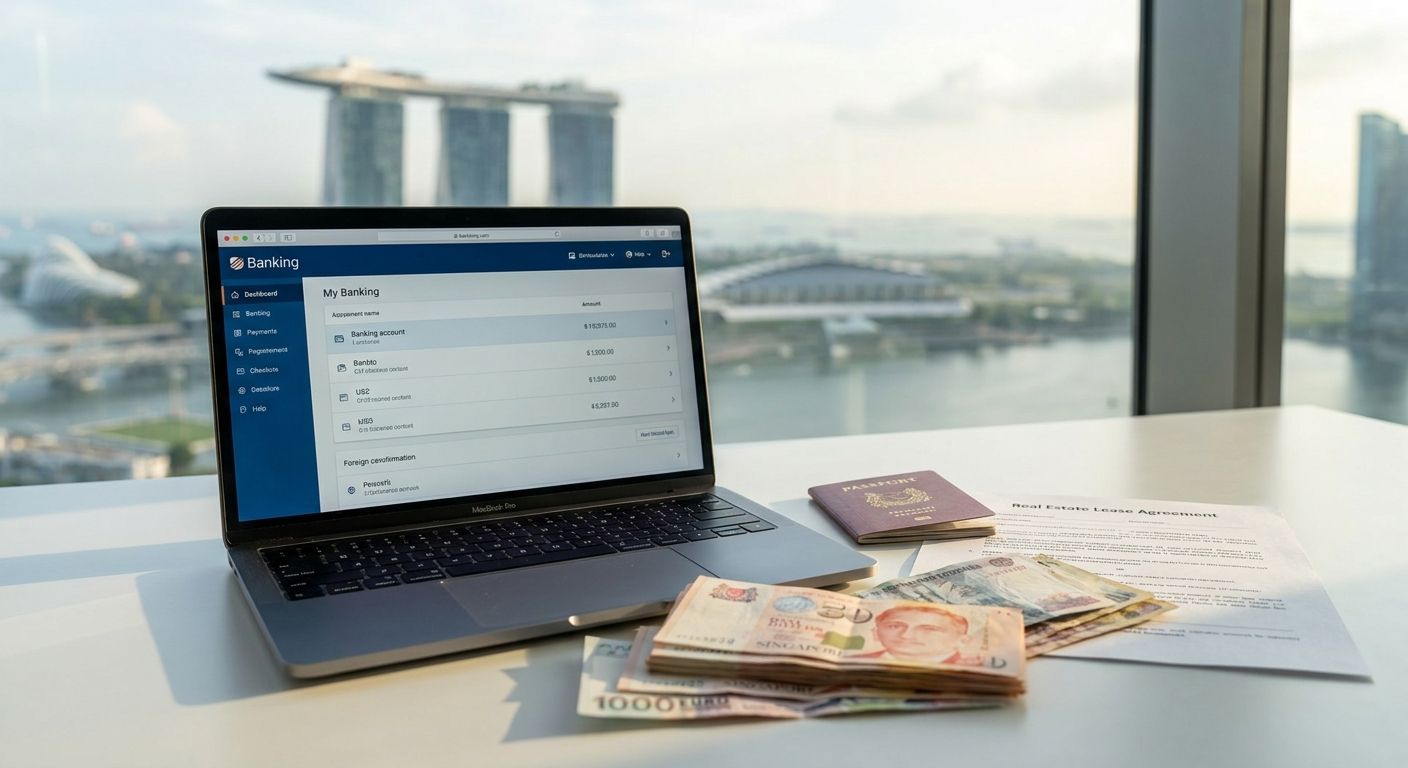
If you own a rental property in Singapore and live overseas, the money is yours to move home whenever you like — Singapore has no exchange controls, so there's no permission slip needed to wire rental income out of the country. The real friction sits in two other places: settling non-resident income tax on that rental income before you file, and giving your bank the source-of-funds paperwork it needs to clear a large international transfer without delay.
- You can repatriate rental income from Singapore property freely in 2026 — no capital controls, no repatriation limits.
- Non-resident individual landlords pay a flat rate on net rental income to IRAS before that money is truly 'yours' to send home.
- Banks apply source-of-funds checks on larger transfers under MAS anti-money-laundering rules, not government repatriation restrictions.
- Landlords holding property through a company face a different, two-step repatriation path via dividends.
- Property agents managing your unit while you're overseas keep the paper trail clean for tax filing and bank checks.
Why this matters
Overseas landlords assume repatriating income from a Singapore property involves the same bureaucracy as markets with capital controls — it doesn't, but that doesn't mean it's frictionless. Get the tax filing sequence wrong and your April deadline slips; get the bank documentation wrong and a transfer sits in review for days while you wonder if something's blocked. Neither problem is about Singapore restricting your money. Both are about paperwork you can prepare in advance.
I work with landlords who left Singapore years ago and still hold the condo they bought as an employment pass holder, plus landlords who never lived here at all and bought purely as an investment. The repatriation mechanics are the same for both groups. What differs is how the property is held and whether tax has actually been settled for the year in question.
How do you repatriate rental income from a Singapore property overseas?
The process runs in a fixed order. Skip a step and you either overpay tax or stall your transfer at the bank.
- Collect rent through a Singapore bank account. Most overseas landlords keep the original local account open rather than closing it — it simplifies both tax reporting and transfers.
- Deduct allowable expenses — property tax, agent commission, repairs, mortgage interest where applicable — to arrive at net rental income. Only net income gets taxed and only net income needs to be tracked for repatriation purposes.
- File your Singapore income tax return as a non-resident. Singapore's tax year runs to 31 December, with individual filing due by 15 April on paper or 18 April via e-filing the following year — miss it and IRAS applies late penalties regardless of where you live.
- Pay the assessed tax. IRAS issues a Notice of Assessment; tax is due within the stated payment window, usually about a month after the notice.
- Wire the after-tax balance overseas. Once tax is settled, there's nothing stopping you from transferring the full remaining amount — the bank just needs to see it's a legitimate, tax-clean rental receipt if it asks.
Verdict: repatriating rental income from a Singapore property in 2026 is unrestricted once your non-resident tax filing is current — the delay landlords hit is almost always a documentation gap, not a legal barrier.
Non-resident individual landlords: flat tax rate before repatriation
If you own the property in your own name and you're not a Singapore tax resident, IRAS taxes your net rental income at a flat non-resident rate rather than the progressive resident scale. That flat rate has sat at 24% from Year of Assessment 2024 onward, up from 22% previously — it applies whether the rent is S$2,000 a month or S$20,000. There's no withholding tax deducted by the tenant or your property agent at source; the obligation to declare and pay sits with you as the landlord, which is exactly why the filing deadline matters more than people expect.
A landlord earning steady rental income and repatriating it every quarter through the year still owes tax as one lump sum after filing — the money can move out ahead of the tax bill, but IRAS will still expect payment on schedule. Some landlords set aside roughly a quarter of net rent through the year specifically so the April payment doesn't create a cash squeeze back home.
Landlords holding property through a company: a different repatriation path
If the property sits in a Singapore-incorporated company rather than your own name — a structure some foreign investors use for succession or liability reasons, covered in more depth in how to structure buying Singapore property through a company — rental income is corporate income first. The company pays Singapore corporate tax, and only after that does profit reach you personally, typically as a dividend. Singapore doesn't tax dividends paid to shareholders, which is a genuine advantage, but the two-step path (rent to company, company to shareholder) adds paperwork a direct individual holding doesn't have.
Verdict: hold the property personally if simplicity of repatriation matters most; use a company structure only when the tax or succession reasons for it outweigh the extra reporting layer.
Why the repatriation timeline varies
The legal path is fixed, but how fast money actually lands overseas depends on a handful of practical factors:
- Bank AML checks on large transfers — anti-money-laundering rules under the Monetary Authority of Singapore mean banks ask for source-of-funds proof on sizeable one-off wires, even when the money is entirely legitimate rental income.
- Whether your tax filing is current — a lapsed or overdue filing is the single most common reason a bank or accountant flags a transfer for extra review.
- Currency conversion timing — converting SGD to your home currency before or after the transfer changes the amount that lands, though it doesn't change whether the transfer is permitted.
- Property holding structure — individual ownership repatriates in one step; company ownership adds a dividend declaration step.
- Property agent management fees and deductions — cleaner books from a managed rental mean less back-and-forth when you or your accountant reconcile net income for the tax return.
- Double tax agreements with your home country — Singapore has an extensive treaty network, and many overseas landlords can claim a foreign tax credit at home for tax already paid in Singapore, which affects planning even if it doesn't affect the repatriation mechanics themselves.
Managing a Singapore rental from overseas?
I handle tenant sourcing, rent collection and paperwork for landlords based abroad.
Do I need IRAS clearance before repatriating rental income?
No formal IRAS clearance certificate is required before you send rental income overseas — that's a step some other countries impose, not Singapore. What matters is that your annual filing is up to date and the tax owed on that income has been paid or is on schedule, since an overdue filing is what triggers extra questions from your bank, not from IRAS itself.
Is there a limit on how much money I can transfer out of Singapore?
There's no government-imposed limit on how much rental income you can transfer out of Singapore in 2026 — the country has no capital controls on outbound personal or investment funds. Banks may still ask for supporting documents on very large single transfers as part of standard anti-money-laundering checks, which is a compliance step, not a cap.
Does my tenant need to withhold tax before paying me rent?
No, tenants and property agents in Singapore don't withhold tax on residential rental payments to individual landlords. The tax obligation on rental income sits entirely with you as the non-resident landlord, settled through your own annual filing with IRAS rather than deducted at the point rent is paid.
FAQ
Can I repatriate rental income from Singapore property to any country?
Yes, Singapore places no restriction on which country you send rental income to once local tax obligations are settled. The receiving country may have its own reporting requirements for incoming foreign income, which is separate from anything Singapore controls.
What tax rate applies to rental income for non-resident landlords in 2026?
Non-resident individual landlords pay a flat 24% on net rental income from Year of Assessment 2024 onward. Net income means rent minus allowable deductions like property tax, agent commission and repairs.
Do I need a Singapore bank account to repatriate rental income?
You need a Singapore bank account to collect the rent in the first place, and keeping it open makes repatriation and tax reconciliation far simpler than closing it after you move overseas. Most overseas landlords keep the original account active for as long as they own the property.
Does selling the property change how I repatriate the proceeds?
Selling triggers a different process from ongoing rental income repatriation, involving the conveyancing lawyer's completion account rather than a simple bank transfer. The guide on how to sell property in Singapore before relocating overseas covers that sequence in full.
Is rental income from Singapore property taxed twice if I live overseas?
It can be, but Singapore's double tax agreement network lets many landlords claim a credit at home for tax already paid here, avoiding true double taxation. Whether that applies depends on the specific treaty between Singapore and your country of residence.
Can a property agent handle repatriation paperwork for me?
A property agent manages the rental, collects rent and keeps the expense records clean, but the tax filing and bank transfer remain the landlord's or their accountant's responsibility. Clean records from professional management make both steps faster.
One last thing
The part that catches overseas landlords out isn't Singapore's rules — it's their own bank's AML process on the transfer side. A rental income wire that's fully tax-compliant can still sit in review for days if the receiving bank overseas wants extra source-of-funds evidence, so keep your IRAS Notice of Assessment and rental statements on hand every year, not just when a transfer gets questioned.